Thursday, 26 October 2017

OUGD501 - Essay Draft Feedback

"Your essay has a nice structure and flow and presents your argument in a really coherent way.

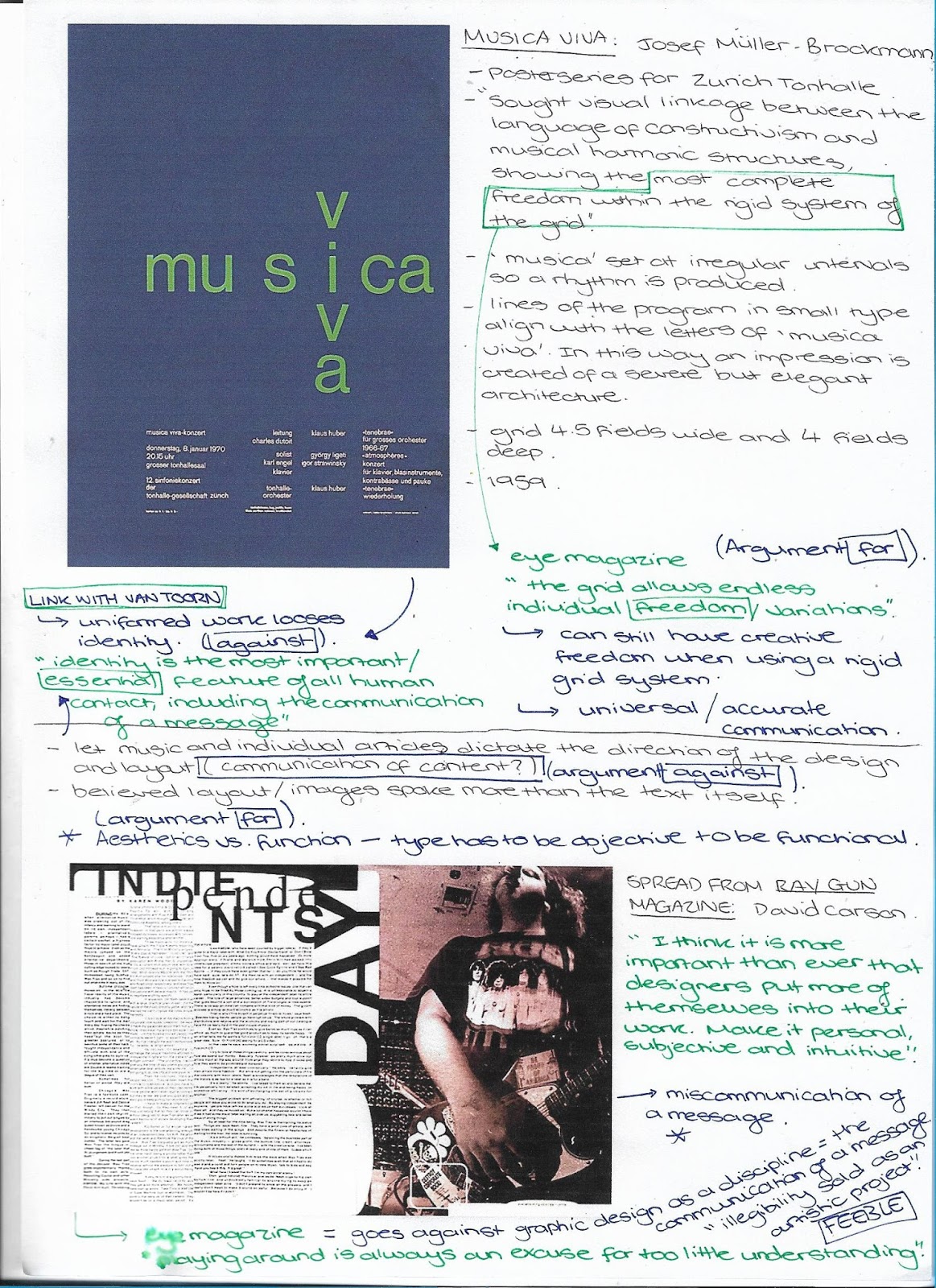
I get the impression that this essay, rather than a critical comparison, is edging more towards a critique of the idea of objectivity in graphic design? Which, actually, i think is much more exciting. In this way, perhaps you can open out this debate to include some postmodernist ideas about objectivity in general. Since postmodern philosophy would tend to condemn any idea of a universal objective truth of any sort.

There are some sketchy sources here though. Wikipedia shouldnt used and don't overly rely on journalistic articles. Rather than building your discussions around single articles use multiple ones - so, for Brockmann use the eye article but also his grid systems book and any other texts you can find by or about him."

OUGD501 - Parody and Pastiche

Linda Hutcheon: The Politics of Postmodernism: Parody and Pastiche.
(Parody)

The argument presented in this text by Hutcheon argues that parodic postermodernism is a good thing and that "genuine historicity" does not exist. She suggests through this that 'the pluralist, provisional, contradictory nature of postmodern enterprise challenges not just aesthetic unities, but also homogenizing social notions of the monothithic (male, Anglo, white, Western) in our culture'.


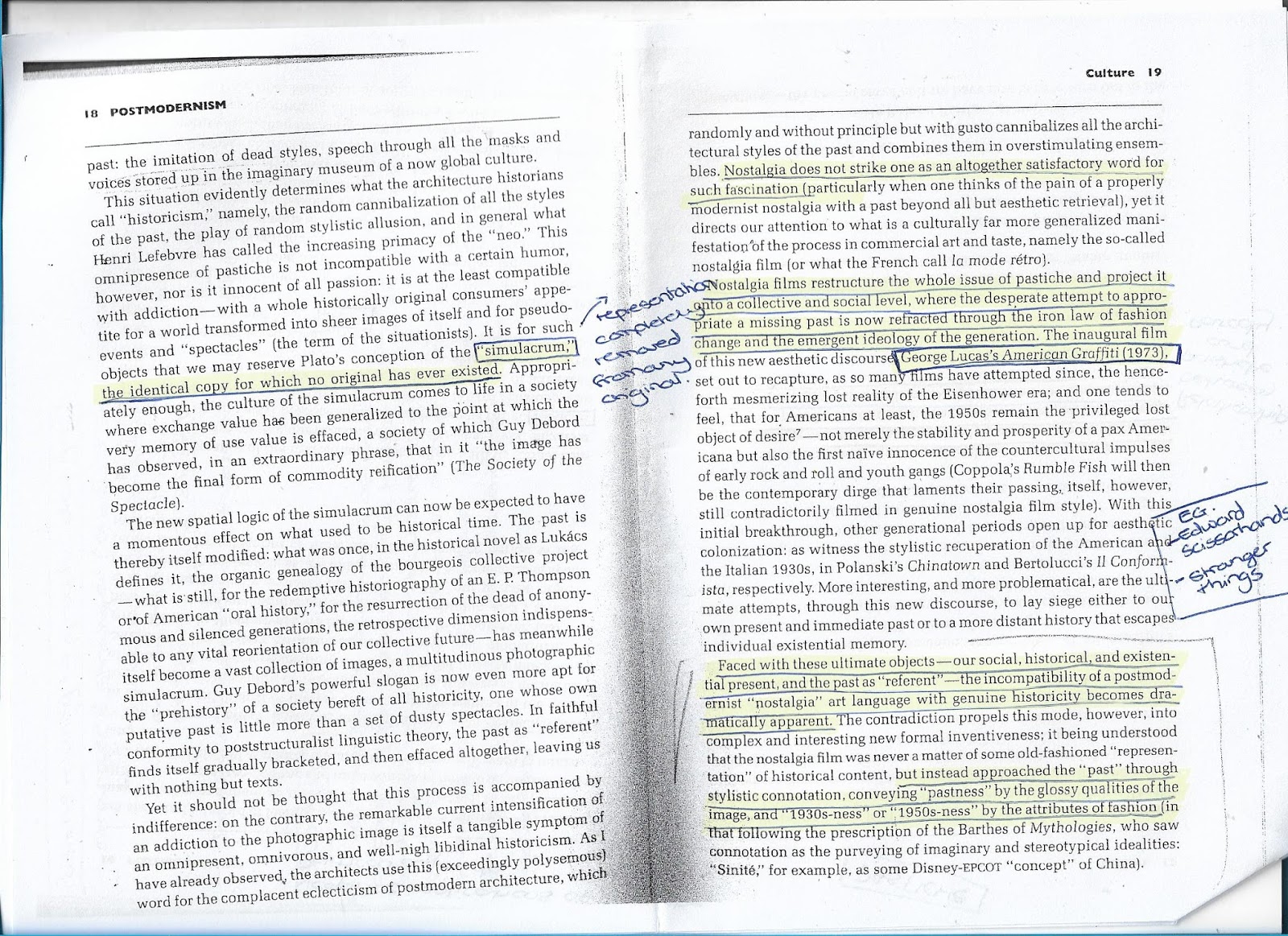
Frederic Jameson: Pastiche.
(Pastiche)

In this text, Jameson talks about the negative implications of pastiche. In considering the relationship between parody and pastiche he states 'parody finds itself without a vocation; it has lived, and that strange new thing pastiche slowly comes to take its place. Pastiche is, like parody, the imitation of a peculiar or unique, idiosyncratic style, the wearing of a linguistic mask, speech in a dead language. Pastiche is thus blank parody'.


Pastiche relating to graphic design:

- Stranger & Stranger (product designers) - Victorian advertising/ type/ etching - early modernist and wartime poster designs, wine labels.
- Jonathon Barnbrook - type designs and influences.

OUGD501 - Male Gaze Theory

Laura Mulvey: Visual Pleasure and Narrative Cinema (1975)

Structure:
1. intro to psychoanalysis as a feminist weapon.
2. radical cinema, emerging from classic Hollywood cinema.
3. explanation of scopophilia and how it relates to cinema.
4. explanation of narcissistic pleasure and how it relates to cinema.
5. summary of cinema and discussion of castration.
6. the roles that men and women play in cinema and spectatorship - active/male, passive/female.
7. a - role of women (on screen), b - role of man (on screen and spectator).
8. structures of the gaze and its relation to castration threat.
9. 2x case studies.
10. summary and conclusion.

Dyer, R. (1979) Stars.

The text describes male gaze as a theory when investigating advertising, social media (for instance, instagram), as well as other sources. This text in particular argues against Mulvey's explanations of male gaze theory, rejecting any form of erotic potential. This can be seen through the quote 'Richard Dyer explores a similar disavouwel of the look by highlighting how male pin-ups never appear in the image to be looking in ways which suggest they are not an erotic object. This can involve looking as if disinterested in the viewer, glancing upwards to appear lost in a high spiritual form of thinking, or staring to confront the fact of being looked at'.


OUGD501 - Visual Analysis and Triangulation


OUGD501 - Digital Culture Lecture

Digital Culture:
Production, Distribution, Function and Audience.


To what extent do technological developments impact on graphic design, etc? (research question). Technology: the application of scientific knowledge for practical purposes, especially in industry. "Advances in computer technology" (define).
Marshall McLuchan
- Look at technology in a range of different ways.
- Driven by how people use technology and what they want - social media landscapes.

Digital culture
- A set of values, beliefs, opinions, skills and practices shard by regular users of digital media for production and distribution.
- Social phenomena of interrelated, online and offline, experiences.
- Offline affects more than just online experiences, for instance, the way we talk.

- Social, cultural, creative relationships formed around them.
- Functions and devices encourage, enable and extend our ability to develop, communicate and distribute content?
- How do we use these devices? What do we use them for? - engage and affects people's lives in different ways.

Principle components of digital culture
- Participation - format and informed online affiliations, connections, collaborations, etc.
- Remediation - new technology and media as a constant developmental remix of older media and the refashioning of old media to meet the demands of new technologies, eg. vinyl/ keypad on a phone - how we engage with digital technology/ familiarity.
- Bricolage - the creation of products through available media.

Fanzines and Bricolage
(remaking of the old).
- Punk zines, 1970's, used cheap methods of production eg. photocopying so that everyone could afford one.
Social Media and Bricolage
- Different way of building credibility and authority through followers, like, comments, etc - global cultural - is anyone looking or listening? Meaningless? No curation or moderation?
The internet has turned what used to be a one-way message into a real-time dialogue with millions.
- Instant distribution (global - send anywhere in the world).
- How we interact with this info eg. QR codes.

"Digital and social media is not about the exploration of technology but service to community" - Simon Mainwaring - commercial drive vs. social function.
"I grew up in a physical world and I speak English. The next generation is growing up in a digital world and speak social" - emojis, etc.

Are we creating a culture where there are higher levels of engagement and interaction?
- Child's learning and development.
- Needs to be physical interaction?
- However, does this make us more innovative?
Dual-relationship between the physical and digital world eg. children's book illustrators and illustrations.
- How do we make the physical seem more innovative? (digital illustrations, production methods, etc).
- Narrative - interaction with information to shape it eg. animations and interactive films for children - the gamification of information to communicate and educate.

Brand - identity - logo.
Brands need to think about what users need more eg. both print and screen variations (full service).
Technologies become integrated into physical environments eg. retail environments.
- We want to be surrounded by it/ shapes our experiences/ interactions with the world.

E.g. Angry Birds - started as a free game - the global scale of it took off to create a business market (brand) - merch/ film.
Transmedia - audience enhancement and engagement/ physical engagement/ no linear storytelling/ full sensory immersion.
- Everything leads back to the physical - speed of consumption.

OUGD501 - Identity and Consumption

JANSSON-BOYD, CATHERINE V. (2010) CONSUMER PSYCHOLOGY:

1. What does she mean by multiple identities? 

According to Brewer (2001) a person can have more than one identity. These are not always anchored in real life, but can be specific to virtual online environments. The number of identities an individual has depends on how many different types of social situations they frequently find themselves in. However, some of these roles are more integral to our identities than others, whilst others may only dominate in certain circumstances.

Consequently, we consume in the hope of reinforcing or establishing the roles we find ourselves in or wish to be in. It's been suggested that these are largely unconscious behaviours, meaning consumers may not be aware that their self identity guides their consumption behaviours.

2. How are identities formed?

It has been researched that, generally, self-recognition starts to develop around the age of two years old. Human identities are continuously moulded and influenced by parents, siblings, societies, etc that they belong to, including advertising and other cultural influences. However, once people reach the stage of adulthood, they tend to more incorporate feelings, motivations, political beliefs, etc, as well as the possessions they own in order to describe themselves. The incorporation of so many different characteristics to express who we are shows that our identities are multi-dimensional.

3. What is social categorisation?

Humans categorise the world around them in relation to themselves. When doing so, people tend to accentuate their perception of others. This can be split into two parts; person perception, which is he perception of others. This is often affected by people's material possessions. Object perception, on the other hand, focuses on the classification of objects, which can be influenced by marketing and advertising.

Because we tend to focus on the groups people belong to and the type of possessions they own, we view them as a representation of what the group and possessions stand for rather than as individuals in their own right. Hence, individuals are perceived as 'prototypes', meaning that we can assign them stereotypical characteristics and treat them accordingly. People already have a clear stereotypical concept of what kind of person would be using a particular product, meaning we can make use of those concepts to accurately categorise others.

4. What is social comparison (upwards/downwards)?

Social comparison is about how people learn about themselves by comparing similarities and differences to others. The continuous comparison to others is driven by a need to maintain and sometimes increase positive self-esteem. Individual self-esteem is linked to feelings of belonging which is supported by being a member of groups. From a consumer perspective, purchasing the right kind of products and services can make them feel as if they belong to certain groups. This is often driven by different types of marketing techniques.

Generally people seek out those who appear to do less well in one form or other, as in that they can make downward social comparisons, meaning when we compare ourselves to those whom do less well, we appear to do better ourselves. Upward social comparison, on the other hand, is when we cannot choose who to compare ourselves with and so end up comparing ourselves o those who are viewed as more competent or desirable. This often happens when consumers are comparing themselves to 'ideal' media images.

5. What is social identity theory?

Social identity theory can be described as 'that part of the individuals self-concept which derives from their knowledge of their membership of a social group(s) together with the value and emotional significance of that membership'. Individuals tend to use brand, products and services to differentiate themselves from others using them to demonstrate their commonality with the groups to which they belong. The symbolic meaning often stems from advertising and other marketing techniques. Marketers offer individuals easy solutions as to how they can achieve full group membership or at least how they can signal that they wish to belong to a specific group.

6. Examples of brand identifications.

  • In a study where Macintosh and PC users were compared, the Macintosh brand was found to be much more likely to be a part of a consumers self-concept. The user tends to think of themselves as a part of a small close-knit community, since it may be that it fosters a 'strong social bond and deep-rooted loyalty'.
  • American Eagle Outfitters used the slogan 'live your life'. The slogan was meant to inform consumers that those wearing American Eagle denim outfits were highly individual people who wished to do something unique with their lives. Hence, if people wish to be viewed as belonging to the group of people in society who are living their life to the limit, they would need to wear American Eagle jeans.
  • Many young girls who play with Barbie dolls have been found to identify with them and think of them as role models. This gives children a skewed picture of what the female ideal should be like, as Barbie is not in any way representative of what real-life women are like.

7. Negative effects on body image.

At times, possessions are used simply as an extension of the self, however these can also be used by individuals to compensate for what is perceived to be flaws in their self-concept. Many studies have found that both men and women do not believe that their current body form is attractive. Such negative body perceptions are most likely the consequence of the media promoting 'ideal identities' that have often been digitally altered.

In the light of unrealistic ideals of physical attractiveness, it is also common for teenagers to conclude that their physical appearance falls short of what society deems to be attractive. Consequently, they embark upon the task of changing their physical appearance, however with impossible targets, that can then lead to poor physical and mental health.

8. What is self-descrepancy theory?

The self-descrepancy theory proposes that people have three types of self-schema (organised sets of expectations and associations about an object). These are:

  • Actual self - the way people are at the point in time.
  • Ideal self - the self that we aspire to be.
  • Ought self - the way we think we should be.

The ideal self helps us to strive to be in a way we think is perfect, whilst our ought self prevents us from doing things that are not in line with what we should be like. It is important that there are no discrepancies between the actual and ideal self, or the actual and ought self, however if there are this can potentially motivate a person to try and reduce it. Those with high discrepancies are more likely to suffer from low self-esteem and has been suggested are also likely to engage in 'identity seeking buying behaviour'. Such findings explain why repeated exposure to 'ideal' unattainable images for most will have a negative impact upon their self.

OUGD501 - The Structure of an Essay


OUGD501 - Setting A Research Question

Based on my Context of Practice 2 proposal submitted in the previous module, it was decided to focus on the use of objectivity and subjectivity within graphic design, particularly focusing on the debate between Wim Crouwel and Jan Van Toorn since this debate was something of interest during first year which I could possibly use to also put my own arguments and beliefs on this topic into practice.

In establishing a research question, there were some points which should be followed:

Focus on a specific graphic design discipline.
- It was thought that the use of grids, layout and typography within graphic design could be one way in which to make the research question and essay more specific, since the debate on objectivity and subjectivity is quite broad (functionality vs. aesthetics).
- Another focus point could also be typography and editorial design (modernism vs. postmodernism).

The question must be open ended.
- Sometimes better to form research question once you have written the essay - let the question be informed by your work.
- Must be contemporary.

The question must allow for suitable theoretical research as well as visual exploration.
- Focusing on a more specific element of graphic design, posed within the research question, should allow for suitable theoretical research in the form of the 1972 debate and how other designers approach design, as well as visual exploration in putting such ideas into practice.

Position your question within contemporary graphic design practice - make it work for you.

Do some quick preliminary research to gauge how much literature is currently available
- Do the same to explore what is currently happening within the industry.
- David Carson, Josef Muller-Brockmann, Jan Van Toorn, Wim Crouwel.

Consider what primary research methods could be used to support your research.
- Explore shops and libraries to see what material is already published on the topic of objectivity and subjectivity, or those which use clear objective or subjective approaches in their design and production.
- Questionnaire to find out why people buy certain graphic design products (function or aesthetics?)
- How much do the ideas of people and demographics play on the design of a piece of work compared to ideas of objectivity and subjectivity?

Monday, 24 April 2017

OUGD401 - End of Module Evaluation

Throughout this Context of Practice module, I have learnt a great deal about the importance of written theory and extensive research within Graphic Design. The research undertaken for this module has helped me learn a great deal about the use of gender stereotypes within advertising, and as a result has made me become more critical of such advertisements. It has taught me the affects these underlying messages about gender can have on consumer societies in guiding people’s buying behaviours to reinforce perceived identities, as well as how they are feeding negatively into children’s career aspirations and skills development. The practical element of this module allowed me then to put this new body of knowledge into practice through producing my own series of advertisements which aimed to raise awareness of the stereotypes typically found in many existing advertisements and their negative impacts. This combination of written theory and practice allowed me to provide strong arguments and justifications of my work, and these links are something I will bring forward, not only in future Context of Practice modules, but also in my own studio practice.

Although plenty of links were made between my written and practical work, these could have been improved through a more variety of resources, as a lot of references came from online content, which may not be one hundred percent reliable. Through Context of Practice 2, I will therefore consider my choice of reference material more carefully to ensure accuracy of information.

The lecture programme has been enjoyable and engaging this year, allowing me to broaden my knowledge in the field of Graphic Design in terms of subjects, such as semiotics, the history of type, modernism, post-modernism and colour theory. All of these subjects will play an important role within future Studio Practice and Context of Practice modules, allowing me to question the intentions of my own and other designers' work in relation to such topics and produce more informed arguments within written work.

Although I have previously studied academic subjects which also required essay writing, I feel Context of Practice has allowed me to continue practising this skill and as a result has improved my essay writing skills. A part of this skill includes Harvard referencing, which I had limited knowledge of previous to this module. In addition, to improve further on this new skill and make the process easier I will remember to keep a record of any sources I have used or found as without them referencing becomes a long and hard process, which could potentially create problems of plagarism if not found.

Overall, Context of Practice has been very engaging, showing me the importance of theory in practice. The content learnt from the lecture programme will allow me to engage more with many aspects of my own overall graphic design practice, as well as giving me to opportunity to form my own arguments and opinions on such subjects.

OUGD401 - Studio Brief 03 - Critical Reflection and Proposal

OUGD401 - Study Task 08 - Outcomes Evaluation

Original intentions for these outcomes were to use completely gender-neutral colours to engage an audience of both males and females, however it was decided to disgard the green and use a lighter shade of yellow to produce the links to gender-neutrality, as well as making the imagery and information clearer to read. Although these posters make use of gender-neutral toys as imagery, the colours of these toys have purposefully been ‘gendered’ in the use of pink and blue. The graphs themselves which are made from these toys do not have any labels to show which column is for boys and which is for girls, however instead the stereotypical attitude that ‘pink is for girls’ and ‘blue is for boys’ has come into play to ‘label’ these columns. These have been used in conjunction with a neutral yellow for the background and the accompanying text which makes the imagery clearer, in order to create a slight contrast that makes the audience engage with the advertisement more, considering its message and how it has been conveyed. For instance, it aims to make the audience question the use of pink and blue, and therefore realise the extent and effect of such gender stereotypes.

However, this can be seen as a complete contradiction to one of the intended messages which aims to shatter gender stereotypes. For this reason, it can be considered that the posters do not completely successfully reach the originally stated intentions.

It was initially stated that one of the main client needs for this advertising campaign would be the use of clear imagery which could be understood by both parents and their children. The use of LEGO blocks and books to produce the columns of a bar graph means that this requirement has been achieved in one aspect, as LEGO is a universally well-known brand of children’s construction toy, which was originally advertised as gender-neutral.

However, it can also be considered that the choice of imagery may not be as easily understandable for children. Although they should be able to relate to the images themselves, it would not be clear for them to interpret the message being conveyed in them, especially younger children who cannot yet read and would therefore not be able to understand the accompanying written information. In this sense, the advertisements are unsuccessful in achieving their originally stated intentions.

Despite this, links to gender and society discussed in critical writing is very clear, showing the impacts of stereotypes portrayed in advertising. For example, themes of beauty directed at young girls puts an early emphasis on their appearance and how society deems them to look. This links to the initial research focus/quote from Jansson-Boyd which stated that “many studies have found that both women and men do not believe that their current body form is attractive… something that is likely to have been reinforced by consumer societies”.

OUGD401 - Study Task 08 - Outcomes

This series of posters were created as part of an advertising campaign for the Let Toys Be Toys campaign. The campaign focuses on working with toy and publishing industries to stop limiting children’s interests by promoting toys and books as only suitable for either boys or girls, and providing more gender-neutral attitudes towards these. The posters aim to shatter the gender stereotypes and beliefs produced by children from a young age which result from those found in children’s toys and advertising. These stereotypes have been found to be having significant effects on children’s skills development, which can then lead into and limit their future lives and career choices. The use of statistics within this campaign aims to raise awareness in parents of the negative impacts of these stereotypes on their children’s development and make them reconsider what they do and do not let their children play with.


Saturday, 8 April 2017

COP Lecture Series: Programme Summary

VISUAL COMMUNICATION:
- A process of sending and receiving messages using type and images.
- It is based on a level of shared understanding of signs, symbols, gestures and objects.
- It is affected by audience, context, media and method of distribution.

VISUAL LITERACY:
- The ability to construct meaning from visual images and types.
- It involves interpreting images of the past, present and from a range of cultures.
- It involves producing images that effectively communicate a message to an audience.
- The ability to interpret, negotiate and make meaning from information presented in the form of an image.

As visual communicators:
- It is our job is to communicate.
- We solve problems of communication through type, image and motion.
- We are interested in words, language, message and meaning.
- We need to be able to effectively communicate ideas, concepts and content to different audiences in a range of contexts.

Questions to consider for COP 2:
- To what extent does social responsibility impact on the role and function of graphic design?
- Globalisation and core British values?
- How have technological developments in production and distribution affected graphic design?
- How has graphic design constructed our understanding or view of historical events and perceptions of truth?
- Aesthetic 'style' and how this could reflect context, audience and function?

OUGD401 - Studio Brief 02 - Rationale

This series of posters were created as part of an advertising campaign for the Let Toys Be Toys campaign. The campaign focuses on working with toy and publishing industries to stop limiting children's interests by promoting toys and books as only suitable for either boys or girls, and providing more gender-neutral attitudes towards these. The posters aim to shatter the gender stereotypes and beliefs produced by children from a young age which result from those found in children's toys and advertising. These stereotypes have been found to be having a significant effect on children's skills development, which can then lead into and limit their future lives and career choices. The use of statistics within this campaign aims to raise awareness in parents of the negative impacts of these stereotypes on their children's development and make them reconsider what they do and do not let their children play with.

Friday, 24 March 2017

COP Lecture Series: Semiotics

Semiotics can be defined as the 'science' of studying signs and their meanings. This idea was developed by Swiss linguist, Ferdinand de Saussure.

Structuralism (came from a French school of thought established mid 20th Century). This looked at the underlying structures of something, however was destroyed by the development of postmodernism.

SIGN
                          SIGN
   
Experience -    signified
                       -------------   |   codes
Utterance   -     signifier

Saussure (1916) ' Course in General Linguistics'.
- Sign = signifier + signified
- The relation between them is arbitrary
- Signs are organised into codes
- STRUCTURALISM

Utterance = evokes meaning/signifies something.
There is no inherent meaning to everything = communication and understanding is therefore just a social construct.
Semiotics destroys the idea that anything has meaning.

IN CONTEXT
e.g. we are socially conditioned to know that the colour red on traffic lights signifies to stop.

According to Barthes (1957) signs signify on two different levels:
1. DENOTATION (literal meaning)
2. CONNOTATION (cultural associations)

In the same way we can unravel meaning in language by understanding the written and the spoken material, we can also unravel meaning in cultural practices, if we take culture as operating like a language.

CODES
A code is a system of signs and symbols. They are found in all forms of cultural practices.
- In order to make sense of cultural artefacts, we need to learn and understand their codes.
- Codes rely on shared knowledge.

PARADIGMS AND SYNTAGMS
Saussure defined two ways in which signs are organised into codes:
1. PARADIGM (a set of signs from which one is to be chosen)
2. SYNTAGM (the message into which the chosen signs are to be combined)
    = all messages involved selection from a paradigm and combination into a syntagm.

e.g. the alphabet is a paradigm - it's meaning is only valid within a shared culture (which can be seen to destabilise universal truths?)

Paradigmatic choices:
e.g. changing shot in TV, typefaces, colour of your front door, etc.
Where there is a choice, there is meaning and the meaning of what is chosen is determined by ---?

Once a unit has been chosen from a paradigm, its combined with other units = this combination is called a SYNTAGM.
e.g. a sentence is a syntagm of words, likewise our clothes are a syntagm of paradigmatic choices of hats, etc.

COP Lecture Series: Post-modernism

Modernism was initially born out of optimism, an aspirational reaction to World War 1, with a view to harness technology to improve people's everyday lives.
Modernism is associated with:

- experimentation
- innovation
- individualism
- progress
- purity
- originality
- seriousness.

The postmodern condition is characterised by:

- exhaustion
- pluralism
- pessimism
- disillusionment with the idea of absolute knowledge.

BUT there is some overlap...

Jean Tinguely 'Homage to New York' (1960)
Described as "a towering contraption composed of found junk, dismembered bicycles, dismantled musical instruments, glass bottles, a meteorological balloon and electric motors in a questionable condition". It was designed to set itself on fire and destroy itself, as a criticism to the trajectory of modern life, and the fallacy of technology.

http://www.nytimes.com/2011/04/10/arts/design/swiss-institutes-destruction-pays-homage-to-jean-tinguely.html

Uses of the term 'post-modernism':
- after modernism (the historical era following the modern)
- contra-modernism (actively against modernism - BACKLASH)
- equivalent to 'late capitalism' (Jameson)
- 'global village' phenomena: globalisation of cultures, races, images, capital, products.

15 July 1972, 3:32pm = according to Charles Jencks, modernism dies and postmodernism starts.
The demolition of the Pruitt - Igoe development, St Louis (the language of postmodernism architecture, 1977).

Postmodernism has an attitude of questioning conventions (especially those set out by modernism)
- postmodernism aesthetics = multiplicity of styles and approaches
- space for 'new voices'
- a reaction to these rules - starts as a critique of the international style/only rule is that there is no rules/celebrates what might otherwise be termed as 'kitsch'.

URBAN SPLASH
Park Hill flats, Sheffield.

Frank Gehry, Guggenheim Museum, Bilbao, 1997.
James Stirling, Neue Staatsgalerie, Stuttgart, Germany, 1977-1983.

J-F Lyotard:
'The Postmodern Condition' (1979)
- 'Incredulity towards metanarratives'
- metanarratives = totalising belief systems
- result = crisis in confidence

HIGH ART/ LOW ART DIVIDE.

Tuesday, 7 March 2017

OUGD401 - Study Task 07 - Developments to Solution Two

Although an interesting concept, the visualisation of this idea did not work as well as originally intended. One major problem that arised from this work was the use of secondary imagery. The images available to me were not of very good quality, and were all quite detailed and structured which made it difficult to combine the different construction sets together.
In addition to this, the style of figurines accompanying both the classic LEGO construction sets and the LEGO Friends sets were of very different styles. Experimentation with combing these figures into different ‘worlds’ resulted in the imagery looking quite inconsistent. In this instance, it was therefore suggested that these scenes would have to be developed and created physically from one set of LEGO in order to achieve the original intention.

In producing these collages, it was decided to hold the images down using masking tape rather than glue. The visibility of these and the rough cutting of the images were used deliberately to give the impression of the handmade, which could potentially touch an audience of parents to young children, reminding them of a personal piece of work created by their children.
The colour yellow was used again in these simple developments to show the idea of gender-neutrality, similar to that of prototype solution one, and link to it’s intended message.


OUGD401 - Study Task 07 - Developments to Solution Three

Based on peer feedback of prototype solution three, it was suggested that the layout was too simple and was not very engaging to look at. Therefore the layout and hierarchy of information had to be reconsidered. In deciding where the information should sit around this image, it was considered that there could potentially be a link made between the layout and the younger target audience of children. This idea lead to experimentation with using varying font sizes and widths in order to create a ‘chaotic’ layout inspired by the idea that children can sometimes be chaotic in their behaviours and their play.

The enlargement of the statement ‘toys have no gender’ creates a powerful message that does not need any support and has been used in the aim of receiving the attention of its intended audience. Although not completely intentional, the split of the word ‘gender’ in this statement can be considered to reflect the shattering of the gender stereotypes typically found within children’s toys and marketing.

Similar to the other prototype solutions, these developments continue the use of Gill Sans, because it was felt that this consideration of type style gave the advertisements an extra link, pushing it more towards the intended audience. In contrast, experimentation was also done using different typefaces, such as Helvetica, however this did not work well in such context of a children’s advertisement as it looked ‘too professional’ and did not create the same impact.


OUGD401 - Study Task 07 - Developments to Solution One

It was decided to take this first prototype solution forward and develop towards a final outcome. One piece of feedback gained from pitching this idea was that the imagery was not very clear and impactful. It was felt that the use of line-art meant the imagery sunk into the background, and so failed to convey the appropriate message. This piece of feedback was taken into consideration and developed so that more colour was incorporated into the design.
Experimentation with colour started by using the same shade of yellow used for the outline of the LEGO blocks to fill them in and using these against the same green background to keep the themes of gender-neutral colours. However, because of the simplicity of the bar graphs this meant it was not instantly clear which column symbolised males and females. Based on this, it was decided to create a contrast with the gender-neutral theme and ‘label’ the columns using the stereotypical colours for boys and girls as pink and blue. Because this colour stereotype is universally known, it would be clear for the audience to identify the message being conveyed in the graphs. The contrast between these colour labels and the message of the advertisements would mean that the audience would potentially enage more with the message and show the impact of such stereotypes through the fact the columns are not labelled through text but colour and the audience still knows what they mean, because of these universal stereotypes.


Further developments in this prototype looked at adding text based on research and the statistics conveyed within the imagery to make the overall message clearer. However, this created another problem in that the text did not stand out enough against the original green background. The background colour was therefore changed to a pale shade of yellow. It was felt this worked better in the composition of the advertisement, as it did not overpower the imagery and text, whilst keeping the originally intended links to gender-neutrality.

Although LEGO bricks a suitable universal and well-known brand of children’s toy, it was felt that this did not have a direct link to one set of information. Therefore, the posters were developed into a series through the addition of illustrated books to produce similar bar graphs that better linked to the piece of research which showed that out of 25 books, 21 showed images of women wearing aprons or in domestic roles.


Tuesday, 28 February 2017

COP Lecture Series: Colour Theory - Subjective Colour

Subjective Colour.
Colour and Contrast (Part two).

(The Interaction of Colour - Albers/ The Art of Colour - Itten).
Tertiary neutral - when the colours cancel out its chromatic value (for example, mixing colour complimentaries). Optical principles still apply to neutral colours.
- dependent on purity of hue, tone and saturation.
- we always see full spectrum colour, the colours are just mixed in different proportions.

Itten's colour contrasts:
1. Tone - can be monochromatic/ spatial quality allowing us to read tonal colours in text.

2. Hue - the greater the distance between hues on a colour wheel, the greater the contrast/ juxtaposition of different hues (isolated colour on different backgrounds, for example, yellow on black, stand out because of this greater contrast)/ the proximity of colour and tone.

3. Saturation - the juxtaposition of light and dark values and their relative saturation.

4. Extension - assigning proportional field sizes in relation to the visual weight of a colour (balance).

5. Temperature - the juxtaposition of hues considered 'warm' and 'cool' (theoretical value, for example, certain colours will start to warm up others).
Slight gradients start to appear when colours are used next to each other - black borders between creates pure colour - optical mixing causes gradients that do not exist.

6. Complementary - for example a high contrast between black and white/ optical effects can be created, for example, 'vibration' (opposite = colour harmonies - when colours sit comfortably together).

7. Simultaneous - formed when boundaries between colour perceptually vibrate (for example, red and green - simultaneous contrast forcing colours onto neutrals).

COP Lecture Series: Colour Theory - Systematic Colour

Part one.
Systematic Colour.

Three area which can relate to how we see colour:
- physical
- physiological
- psychological

Spectral colour - colour that is evoked by a single wavelength of light in a visible spectrum. This single wavelength generates monochromatic light.
Every wavelength is perceived as a spectral colour in a continuous spectrum.
The colours of similar or sufficiently close wavelengths are often indistinguishable by the human eye.

Colour is based on light - each colour has a different wavelength.
White light hits something physical and splits into colour - travels at different wavelengths and speeds, eg. red produces longer wavelengths and purple, shorter wavelengths.

Our perception of any colour is based on the eye receiving light which has been reflected from a surface or object.
White takes on the colour around it, whereas black absorbs more light so retains more of its colour. The colour of the surface will also affect a colour.
For example, the sky is pure white light - wavelengths bouncing off everything produce its colour, such as particles/ shorter and longer wavelengths, such as sunsets/ the sky has no colour.

The eye contains two kinds of receptors:
RODS - convey shades of black, white and grey.
CONES - allow the brain to perceive colour.

There are three types of cones:
1. sensitive to red-orange light.
2. sensitive to green light.
3. sensitive to blue-violet light.

When a single cone is stimulated, the brain perceives the corresponding colour.
If our green cones are stimulated, we see 'green'/ if our red-orange cones are stimulated, we see red'/ if both our green and red-orange cones are simultaneously stimulated, our perception is 'yellow' - Yellow does not exist as a colour.
Because of this physiological response, the eye can be 'fooled' into seeing the full range of visible colours through the proportionate adjustment of just three colours: red, green and blue.
The way we perceive colour can be affected by different physiological aspects, for example, colour blindness.

Part two.
The Principles of Colour.

Josef Albers (1888 - 1976)
Johannes Itten (1888 - 1967)

Colour - pigment - media.
Primary - secondary - tertiary.

Mixing primary, secondary and tertiary colours eventually cancel each other's wavelengths out and the colour becomes a neutral grey.

Spectral colour - the eye cannot differentiate between spectral yellow and some combination of red and green. The same effect accounts for our perception of cyan, magenta and other in-between spectral colours.
Colour modes: RGB - screen based colour (additive)/ CMYK - print based colour (subtractive).
The primaries of RGB provide secondaries of CMYK.

Part three.
Dimensions of Colour.

Chromatic value = hue + tone (luminance) + saturation.
Luminance (shade)
- how much light does it reflect?
- tint - adding more white.
- tone - adding white/ dark.
Saturation
- amount of colour we see.

Conclusion: we always see colour in relation to something else. The Pantone colour matching system can help with this in reproducing exact colours for design work.

Tuesday, 21 February 2017

OUGD401 - Study Task 06 - Prototype Solutions

PROTOTYPE SOLUTIONS 01

This first proposed solution was taken from initial ideas generation in suggesting an advertising campaign which would consist of a poster/series of posters that give statistics on the negative impacts of gender stereotypes in children's toys and advertising on their development. This first proposed solution was taken from initial ideas generation in suggesting an advertising campaign which would consist of a poster or series of posters that give statistics on the negative impacts of gender stereotypes in children’s toys and advertising on their development.

The imagery shows two simple bar graphs made from illustrations of LEGO blocks. This idea was again based on the piece of research from Narahara (1998) which suggests that children are more likely to undervalue something if they cannot relate or identify with it. The aim in using a universally-known toy was so that children and their parents could relate with the toy and therefore engage more with the advertisement.

The colours used within this prototype solution also use the idea of gender-neutrality. Yellow and green are not typically associated with either boys or girls, but both genders, as well as being two of the common colours found within classic LEGO construction sets. As a result, this aims to show that you do not always need to use gender stereotypes within advertising in order to gain a reaction, as some research showed that people working in advertising sometimes use such stereotypes purposefully in order to gain profits. For instance, it is assumed that consumers would feel uncomfortable buying a toy labelled as “for girls” for a boy or vice versa. This means that consumers are forced to buy two sets for a boy and a girl, rather than handing toys down to another generation. Based on this research, the use of green and yellow colours would mean that the advertisements aim to target an audience consisting of both males and females, as gender stereotypes are increasingly affecting both, particularly in terms of children’s toys, their play, skills development, and essentially their future careers.


PROTOTYPE SOLUTION 02

The second prototype solution was taken from initial ideas generation in suggesting the combination of the classic LEGO construction set and the new LEGO Friends set, which was designed specifically for girls. LEGO originally branded itself as a universal construction toy, however the introduction of this set designed ‘for girls’ brings in a new body of stereotypes into children’s play. Through combining the two sets of LEGO, this prototype solution aims to communicate how such stereotypes in children’s play is limiting their future lives because they do not adequately develop skills, such as fine motor and perseverance, which they gain from a broad range of play and toys.

The materials used for this solution use secondary imagery of various LEGO sets from both ranges that have been collated into hand-cut collages. Images show rough sketches and simple collages on how these could potentially look. The use of collage has been used to relate subtly to child-like creative play and so promotes the development of this skill, whilst also potentially gaining a younger audience. This uses similar research to that of pototype solution one in using imagery that children could potentially identify with and therefore engage with the material more. In a similar sense, it would also attract the attention of parents who would relate the choice of materials and imagery to work of their children, therefore giving the advertisements a personal touch almost.


The imagery would be accompanied by a bold statement of text, such as ‘let toys be toys’ or ‘what it is is gender-neutral’ which takes inspiration from visual examples of exisiting LEGO advertisements. This text would use either Gill Sans or Pragmata Pro Italic, which both have apparent links to children’s books and toys. Gill Sans was used for elements of cover information on the 1935 Penguin books, whereas Pragmata Pro Italic has similar characteristics to that of the typeface used for LEGO’s logotype. Both of these would add subtly to the relatability of the advertisements because of their use within children’s play and learning.


PROTOTYPE SOLUTION 03

The aim of this final prototype solution was to create two advertisements: one which uses completely neutral colours and another which uses ‘gendered’ colours in order to explore whether or not it is possible to create an effective piece of work without the stereotypes typically portrayed in many exisiting advertisements.

Another variation of this idea could be to combine a stereotypical feminine toy with a stereotypically masculine colour, and vice versa. For instance, combining a Barbie doll with a blue background. This variation would aim to make the younger audience question what toys they consider for boys and for girls, in the hope that messages conveyed from this piece of work would later on influence how they play and what they play with. As a result, this would successfully link back to the initial research question and start to reduce the negative impacts on children’s development so that they are able to express themselves in more ways that may eventually lead into their future lives and careers.

For instance, the imagery used in these prototype mock-ups depict a toy train, which could stereotypically be seen as a boys toy. One variation pairs this image with a neutral green background, whilst the other pairs the image with a stereotypically ‘girly’ shade of pink.


The black lines depicted on the pink variation symbolises where a body of text would potentially sit within the design. The layout of this was influence by the ‘what it is is beautiful’ LEGO advertisements, which have a clear structure and hierarchy of information, with the image sitting in the middle and being the main focus of the advertisement.


OUGD401 - Studio Brief 02 - Initial Idea 2

Idea Two:
This idea is to show the negative impacts on a child's development when they only play with toys considered for their gender. Research has shown that children need to access a range of toys and play experiences in order to develop areas such as spatial, social, perseverance and fine motor skills. For example, toys focused on action, construction and technology help with spatial skills, problem solving and encourage being active. Toys focused on role play allow children to practice social skills, and arts and crafts help with fine motor skills and perseverance. Boys and girls need the chance to develop all these areas, however many stores divide toys into separate sections, which means both miss out. These ideas would be communicated in a style similar to that of an unknown designer researched during the module OUGD402. A series of posters would be produced featuring three-dimensional graphs and charts made from children's toys, such as Lego bricks, in order to show statistics and research into children's development when they do not have the chance to access all areas of play.

Materials:
Lego bricks would make up bars on a graph, whilst various children's toys such as model trains and Barbie dolls would make up the different sections of a pie chart. The toys would represent a corresponding skill which can be developed in children from play with this toy.

OUGD401 - Studio Brief 02 - Initial Idea 1

Idea One:
Lego is considered a universal construction toy, which is not made for any specific gender. However, recently the company have brought out a 'Lego Friends' series which is marketed specifically towards girls. This Lego Friends sets seem to be bringing in a new stereotype into the world of Lego, suggesting that these sets are specifically for girls and include scenes which are considered 'girly' such as a catwalk. This first idea is to combine the two worlds together and show the classic male figures in the Lego Friends world carrying out typically 'girly' things. This will then be used in contrast to the 'Friends' figures which will be shown carrying out typically 'manly' tasks, such as building construction. This idea aims to shatter the gender stereotypes which are produced by children from an early age, suggesting they already have a clear idea as to what jobs or toys are suitable for females. These will be in the form of advertisement posters and also aim to communicate how children need all skills producing from toys such as construction, technology, arts and crafts, etc to help in their development. For example, of fine motor, spatial, perseverance and social skills.

Alternative Idea: 
Show a single Lego figure rather than a whole scene and depict these in different uniforms and job roles, again aiming to shatter such gender stereotypes made (or forced upon) by children at a young age. For example, show a female figure wearing a construction uniform to show such jobs are not only aimed towards men.

Materials:
Use physical Lego construction kits and figures to produce these scenes and create more of an impact. These sets would have to be well-considered so that the same set can be used for multiple scenes - first consider the scenes and composition of the images.
If this proves to be too complicated, consider the use of collage, depicting each figure into different scenes, such as those suggested.

Audience:
These advertising campaign posters will be aimed at both adults, as well as children. The use of a well-known brand and child's toy would attract the attention of children who would instantly recognise the toy. This would mean that they engage more with the poster and start to realise that neither toys nor jobs have a gender. Adults, in particular mothers and fathers, would also engage with the advertisements in wanting their children to have freedom in what they play with, as well as helping with their development.

OUGD401 - Study Task 06 - Idea Generation


Tuesday, 17 January 2017

COP Lecture Series: Consumerism

Persuasion, society, brand and culture.

Sigmund Freud (1856 - 1939)

  • psychoanalysis.
  • hidden primitive sexual desires/forces and animal instincts which need controlling,
    - otherwise civilised society does not work.
    - repressed desires.
  • Freud's model of personality structure,
    - unconscious and conscious mind.
    - id, ego and superego.
Edward Bernays (1891 - 1995)
  • press agent, employed by public information in WW1 (propaganda).
  • birth of public relations (PR).
  • based on ideas of Freud (his uncle).
  • 1929 Easter day parade
    - hired actresses to walk down parade and light up cigarettes at symbolic points (PR stunt).
    - "Torches of Freedom".
1924
  • product placement/celebrity endorsements.
  • use of pseudo-scientific reports.
    - attempts to attach desirable qualities to products not often considered desirable.
Fordism
  • Henry Ford (1863 - 1947).
  • making through production lines,
    - speed of production/mass production.
  • crisis of over-production and under-consumption?
  • a society based on needs to one based on desires.
1957
  • marketing hidden needs (8 tactics from 'The Hidden Persuaders', Vance Packard):
    - selling emotional security.
    - selling reassurance of worth.
    - selling ego-gratification.
    - selling creative outlets.
    - selling love objects.
    - selling sense of power.
    - selling sense of roots.
    - selling immortality.
1920
  • 'Manufacturing Consent', Walter Lippmann.
  • a new elite needed.
  • October 24, 1929
    - 'Black Tuesday'.
    - The Great Depression.
Roosevelt and the 'New Deal' (1933 - 1936)
  • welfare state.
  • regulated markets, etc.
  • New York World's Fair (1940)
    - advertising consumerism.
    - Bernays, propaganda ('democracity').
    - beliefs in freedom, etc.
Conclusion
  • consumerism is an ideological project.
  • we believe that through consumption our desires can be met.
  • The Consumer Self.
  • the legacy of Bernays/PR can be felt in all aspects of 21st Century society.
  • conflicts between alternative models of social organisation continue today.
  • to what extent are our lives 'free' under the Western consumerist system?

Tuesday, 3 January 2017

OUGD401 - Study Task 05 - Visual Examples

- identify and analyse relevant and related visual examples.
- 4 x relevant graphic design works and explain how each will help inform your design treatment.


- universal building sets.
- use of LEGO blocks to create imagery - combine classic Lego construction sets with the recent Lego Friends sets which have been marketed specifically towards girls which eliminates the idea of Lego as a universal building set and reinforcing gender stereotypes within children's toys - show how both can still be universal.
- use to show potential negative impacts on children's development when limited in play and how this can affect their ideas of occupation and education.


- statistics from research into the impacts of gendered toys on children's attitudes and beliefs.
- use imagery of children's toys (gendered and not) to produce charts that show this research and statistics, e.g. LEGO blocks to form a bar graph or use of illustrated children's toys and categorise into pie chart.
- aim to shock parents into realising the effects gendered children's toys and products are having on them - change their attitudes and consumer buying habits - engage them by using relatable and well-known products/imagery.


- campaign by Brain Candy Toys - mission to keep kids thinking - takes classic fairy tales and nursery rhymes and imagines what they would be like if they were told using maths equations instead of words.
- how to engage children with the advertisements - the use of universal, well-known children's toy(s) so that young children engage with the advertisements along with their parents and think about what they play with and how they play - shattering their 'learnt' gender stereotypes and attitudes towards play, education and occupation, etc that could potentially impact on them later in life.


- "organising merchandise by gender acts as a barrier that prevents children from exploring a wide array of toys and activities available to them - "because gender segmenting toys interferes with a child's own creative expression".
- use this piece of research as another potential part of the imagery for an advertising campaign - focus on a child's creative expression and individual personality to suggest they are free to choose what they play with and what they wear, etc, opposing the idea of gendered products.
- use of neutral colours, such as yellow and green, rather than the stereotyped pink and blue.

OUGD401 - Study Task 05 - Target Audience Research

GEOGRAPHIC
Geographic segmentation is when a business divides its market on the basis of geography. You can geographically segment a marker by area, such as cities, counties, regions, countries and international regions. You can also break a market down into rural, suburban and urban areas. A geographic target market can be consumers in a city, state or country.

DEMOGRAPHIC
Demographic segmentation means identifying markets based on several shared traits, including age, race, gender, marital status, income, education and occupation. This is also known as a socioeconomic target market.

- parents to young children (20-50).
- young children (0-12).
- infant and primary education level.

PSYCHOGRAPHIC
Psychographic segmentation involves dividing your market into segments based upon different personality traits, values, attitudes, interests and lifestyles of consumers. A psychographic target market would be a market that has these similar attitudes.

- consumers who may not be aware of the restricted choices they are offered, for instance in the 'girls' section or 'boys' section or those who feel uncomfortable buying toys labelled or marketed as for one gender and handing it to the other.
- children who have grown-up with clear stereotyped attitudes and ideas about what is acceptable for boys and girls.

OUGD401 - Study Task 05 - Contextual Research

- 4 x relevant areas of contextual research/information that will inform your design strategy.
- at least one area must be related to your chosen cop theme.

"LEGOs were 'Universal Building Sets' and that's exactly what they were...for boys and girls. Toys are supposed to foster creativity. But nowadays, it seems that a lot more toys already have messages built into them before a child even opens the pink or blue package. In 1981, LEGOs were simple and gender-neutral, and the creativity of the child produced the message. In 2014, it's the reverse: the toy delivers a message to the child, and this message is weirdly about gender".

- the introduction of toys aimed specifically at boys or girls, e.g. LEGO Friends sets. LEGO was founded in 1932 and produced as a 'universal building set' however the recent introduction of gender specific LEGO sets limits children in what they can build and focuses on what they think girls are more interested in, such as makeup and fashion, and boys, construction.

- links to society - research shows that by primary age children have a clear idea about the jobs that are seen as suitable for boys and girls due to stereotypes seen in children's toys and marketing.

https://www.bustle.com/articles/15378-little-girl-from-1981-gender-neutral-lego-ad-tells-the-story-in-her-own-words

"The children's toys section in the basement categories products by gender and displays signs saying 'girls toys' and 'boys toys' above the shelves. This perpetuates gender stereotypes and subtly but powerfully shapes the thinking of children (and their parents), constraining their minds and stifling their full potential. It discourages boys from playing with dolls, and girls from playing with LEGO".

- links to consumer society - what may be driving profit margins is limiting childrens' choice and experiences.

http://www.huffingtonpost.co.uk/chi-onwurah/let-toys-be-toys-gender-marketing_b_4728423.html

"The impact of sex-specific toy choice has implications for children's learning and attitudes far beyond the playground. Play with masculine toys is associated with large motor development and spatial skills and play with feminine toys is associated with fine motor development, language development and social skills".

- negative impacts associated with gender-specific toys - limits development in social, fine motor, spacial and perseverance skills - "children may then extend this perspective from toys and clothes into future roles, occupations and characteristics" - it was found in 2008 by a team of researchers that children with gender-stereotyped decorations in their bedrooms also held more stereotypical attitudes towards boys and girls.

- organising merchandise by gender acts as a barrier that prevents children from exploring a wide array of toys and activities available to them - "because gender segmenting toys interferes with a child's own creative expression".

http://nytlive.nytimes.com/womenintheworld/2015/08/12/how-gender-specific-toys-can-negatively-impact-a-childs-development/

"How toys are labelled and displayed affects consumers' buying habits. Many people feel uncomfortable buying a boy a pink toy, or a girl a toy labelled as 'for boys'".

- links to consumer society - companies use this idea to drive profit - means consumers are almost pressured into buying two different sets of toys for a boy and a girl as they feel uncomfortable buying a product labelled for a specific gender, e.g. seen as not acceptable to hand down a pink bike to a boy.

"The stereotypes we see in toy marketing connect with the inequalities we see in adult life. By late primary age, research shows that children already have very clear ideas about the jobs that are suitable for boys and girls".

- links to society and gender - stereotyped attitudes towards children's toys and marketing can be harmful, e.g. themes of beauty directed at young girls puts an emphasis on their appearance/themes of action and violence feeds low expectations in more sensitive and creative boys, which could potentially undermine their performance at school.

- links to Jansson-Boyd, Consumer Psychology - "many studies have found that both women and men do not believe that their current body form is attractive. Research has repeatedly found that physically attractive individuals are perceived by most to be socially more desirable then those that are perceived as being unattractive, something that is likely to have been reinforced by consumer societies" - reinforced at a young age due to stereotyped children's toys.

http://lettoysbetoys.org.uk/why-it-matters/